
Before you sell or let
Which apartment upgrades add value in Dubai?
No Dubai authority or developer publishes what an upgrade adds to a sale price. What they do publish decides it anyway: which upgrades a tower allows, what they cost to approve, and which unapproved ones can stall a sale.
Value
Apartment upgrades that add value start with the rulebook
Apartment upgrades that add value in Dubai share one thing before any question of taste: the building approved them. A resale runs through developer and Dubai Land Department paperwork, and Emaar's own documents are blunt about what unapproved works do at that stage. The rest of the choice is cost against what the building allows, and both are published.
Which apartment upgrades add value in Dubai?
The ones the building has approved and a buyer can see on paper. No authority or developer publishes a resale uplift for any upgrade, but Emaar lists what unapproved work costs: the defect liability warranty, the ability to transfer or resell, and the ability to apply for a title deed. Within the rules, the approval-light upgrades are the ones Dubai Municipality treats as basic maintenance: painting, new floors laid to the building's rules, doors, suspended ceilings and servicing the electrical, plumbing and AC. Published budgets for a basic one or two-bedroom refresh start at AED 15,000.
Why can an unapproved upgrade subtract value?
Because it stays with the property. Emaar's home modifications factsheet lists the risks of unapproved works as loss of the defect liability warranty, inability to transfer or resell the property, inability to apply for a title deed, and violation notices from Emaar or the authorities. Dubai Holding's schedule for works without prior approval runs from a warning to an AED 2,000 fine to double that, and Town Square's manual sets AED 50,000 for an unapproved major alteration. A sale is exactly when these surface, in communities such as Nakheel's where a developer resale NOC is part of the transfer.
Which upgrades need no permit?
Dubai Municipality's Resolution 109 sets the list: interior and exterior painting, replacing floors, doors and suspended ceilings, and maintaining electrical works, sanitary installations, air conditioners, fire-fighting systems and insulation. None needs a permit or a completion certificate, provided a pre-qualified contractor does the work. Emaar adds its own no-NOC list for apartments, internal painting, furniture installations, electrical fixtures and accessories, and regular maintenance, though every contractor still needs an entry permit.
Those are the upgrades a seller can make without a permit trail, and the building still sets their limits: floors go over the existing tiles in Emaar and Town Square apartments, and nothing may move or cover the fire-fighting services.
What does a Town Square tier list tell a seller?
Which upgrades are cheap to approve. Nshama publishes three fee tiers with their scope lists, and for an apartment they read as a price list for paperwork.
| Tier | Fee and review | Examples from Nshama's list |
|---|---|---|
| Home improvement | AED 160 | Interior repainting and wallpaper, SPC tiles on top of existing, interior lighting, shower glass partition |
| Minor | AED 1,000, 2 working days | Replacing kitchen cabinets, wardrobes and doors; tiles glued on top of existing |
| Major | AED 2,000 plus AED 5,000 deposit, 5 working days | Replacing kitchen counters or islands; false ceilings |
Bathtub-to-shower conversions, wet-area tile replacement and interior wall removal sit on the townhouse side only, so a Town Square apartment owner cannot offer them to a buyer.
Kitchens and bathrooms inside the building's limits
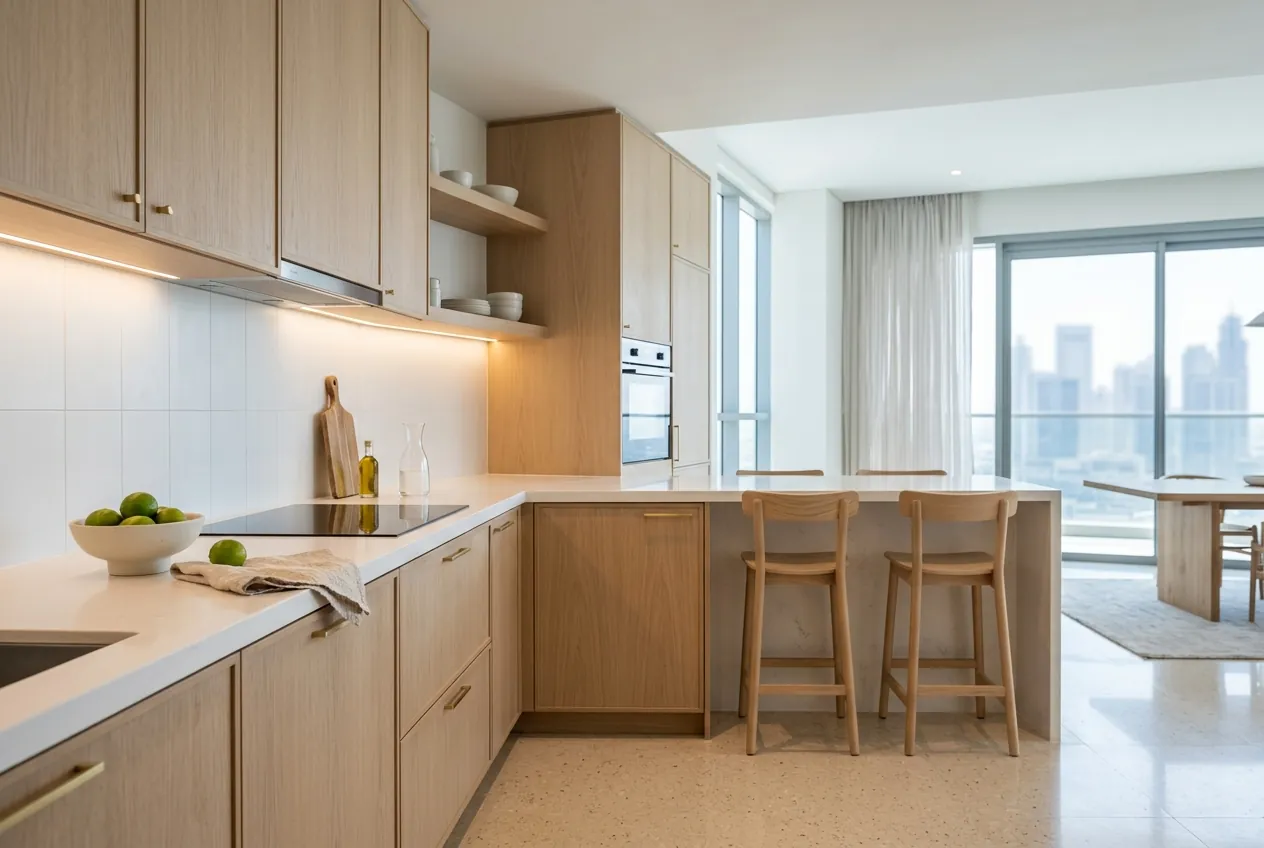
The rooms with the most services are the ones the building fixes in place. Emaar does not allow MEP and fire-fighting systems to be removed, relocated or covered in apartments, which keeps the sink, the hob's connections and the bathroom drains where they are. Within that, ASM Interiors publishes AED 15,000 to 80,000 for a kitchen inside a Dubai apartment renovation and AED 8,000 to 40,000 per bathroom. Vision Three publishes that apartments cost 15 to 25 percent more than villas at the same specification, because of building access and logistics.
Both rooms have their own sites when they are the whole job: kitchen quotes and bathroom quotes.
What does a studio refresh in JVC cost before it is let?
Jumeirah Village Circle is a Dubai Holding community with no design code of its own, so a refresh there runs on the Dubai Holding rulebook. Internal painting, routine maintenance and like-for-like replacement need no permit. Anything beyond that needs an application on the community app at least 24 hours ahead, and a minor modification lasting more than a day needs a permit valid for up to seven days.
Published studio budgets run from Revive Hub's AED 18,000 to 60,000 and First Unicorn Interiors' AED 25,000 to 50,000, and Vision Three publishes AED 35,000 to 80,000 for a studio or one-bedroom refresh. The lowest published studio floor is less than a quarter of the highest ceiling. No company publishes a rental yield for JVC studios, so the case for a refresh rests on its scope and its cost, which is why a letting refresh should be briefed as a list of rooms and trades, not a budget.
The papers a buyer will ask for
Approval evidence for every change, kept in one folder: the NOC or tier approval, the contractor's permits, any completion certificate and the manager's inspection sign-off. In Nakheel communities a resale NOC costs AED 500 plus VAT, is valid for 30 days and is issued in 2 to 3 working days, as nakheel.com listed when read in September 2026. Dubai Properties lists a Resale NOC among its online services, and Tilal Al Ghaf charges AED 500 for an NOC to the Dubai Land Department on completed units.
Title comes before finishes. In January 2025 the Dubai Land Department opened 128 plots on Sheikh Zayed Road and 329 in Al Jaddaf to conversion to freehold for all nationalities, at 30 percent of the property's valuation based on gross floor area. Whether a plot is freehold is set by Regulation No. 3 of 2006 and its amendments, and the hub's freehold guide covers it. For the upgrades themselves, our apartment brief and the bands by tier are the place to start.
Questions
Upgrade questions
- Should I renovate an apartment before selling in Dubai?
- Only with the approvals in hand. No authority publishes what a renovation adds to a Dubai sale price, while Emaar spells out what unapproved works can do to a transfer. A repaint and new floors laid to the building's rules need no Municipality permit; anything bigger needs the building's NOC before the buyer's checks begin.
- Does a new kitchen add value to an apartment?
- No Dubai source publishes a resale figure for a kitchen. What is published is the cost, ASM Interiors' AED 15,000 to 80,000 for a kitchen inside an apartment renovation, and in Emaar towers the rule that the kitchen's services stay where they are.
- Which upgrades are forbidden in Dubai towers?
- Emaar does not permit structural works, wall removal, removing existing tiles or moving MEP and fire-fighting systems in apartments. Dubai Holding needs prior written approval for balcony enclosures, façade changes, satellite dishes, external AC units and heavy planters on balconies. Town Square prohibits balcony enclosures outright.
- Do upgrades cost more in an apartment than in a villa?
- Per square foot they can. Vision Three publishes that apartments sit 15 to 25 percent above villas at the same specification, because of access restrictions and logistics in buildings.
- Can I enclose a balcony to gain space?
- Not in Town Square, where balcony enclosures are prohibited, and not without Dubai Holding's prior written approval in its communities. Emaar does not permit balcony enclosures in townhouses; for its apartments, ask Emaar in writing before anyone prices it.
Who you are dealing with
- OperatorWebsiteOS LLC
- Licence2646567.01
- Cost to homeownerNone
- Figures datedSeptember 2026
Tell us about the apartment
Tower, community, whether you are selling or letting, and the rooms you want to upgrade. We come back with contractors who quote only what your building allows.