
Floors
Can you change the flooring in a leasehold apartment?
Usually, with two conditions. Whoever holds the property has to agree in writing, and in Emaar and Town Square apartments the new floor goes on top of the old tiles, never in place of them.
Floors
Changing flooring in a leasehold apartment: consent, then the rulebook
Changing flooring in a leasehold apartment looks like the simplest job in a tower, and it is restricted from two sides. Dubai Municipality treats a new floor as basic maintenance with no permit. The building often forbids the obvious method, breaking out the old tiles. And a leaseholder, usufruct holder or tenant needs the consent of whoever holds the property before either question matters.
Can you change the flooring in a leasehold apartment in Dubai?
Usually, yes. Dubai Municipality counts replacing floors as basic maintenance, needing no permit when a pre-qualified contractor lays them. The limits come from elsewhere: Emaar does not allow existing tiles to be removed in its apartments, only new tiles laid over them; Town Square's apartment manual says the same and excludes balconies; and Tilal Al Ghaf requires written consent just to alter or replace floor coverings. If you rent, or hold a usufruct or a long lease, the owner's written consent comes first.
Who has to agree to new floors in a leasehold apartment?
The person with the right to change the property, who is not always the person living in it. Dubai's freehold regulation, No. 3 of 2006, designates ownership areas plot by plot, and the same regulation makes one Nad Al Sheba plot usufruct or leasehold for up to 99 years only. In Abu Dhabi, Law No. 19 of 2005 separates a musataha, which allows use, construction or alteration, from a usufruct, which allows use without changing the property. A tenant on an Ejari holds neither, and needs the owner's written approval; Dubai Municipality's décor circular makes that approval a condition of any décor a tenant commissions.
Some estates are let as a whole. Dubai Residential rents out The Gardens and Ghoroob with no individual owners, so a tenant there asks the landlord and nobody else. Read your title deed, usufruct contract or tenancy contract for what it says about alterations, and get consent in writing with the flooring type named. The hub's renting guide sets out what the consent letter should cover.
Why do Dubai towers say tiles over tiles?
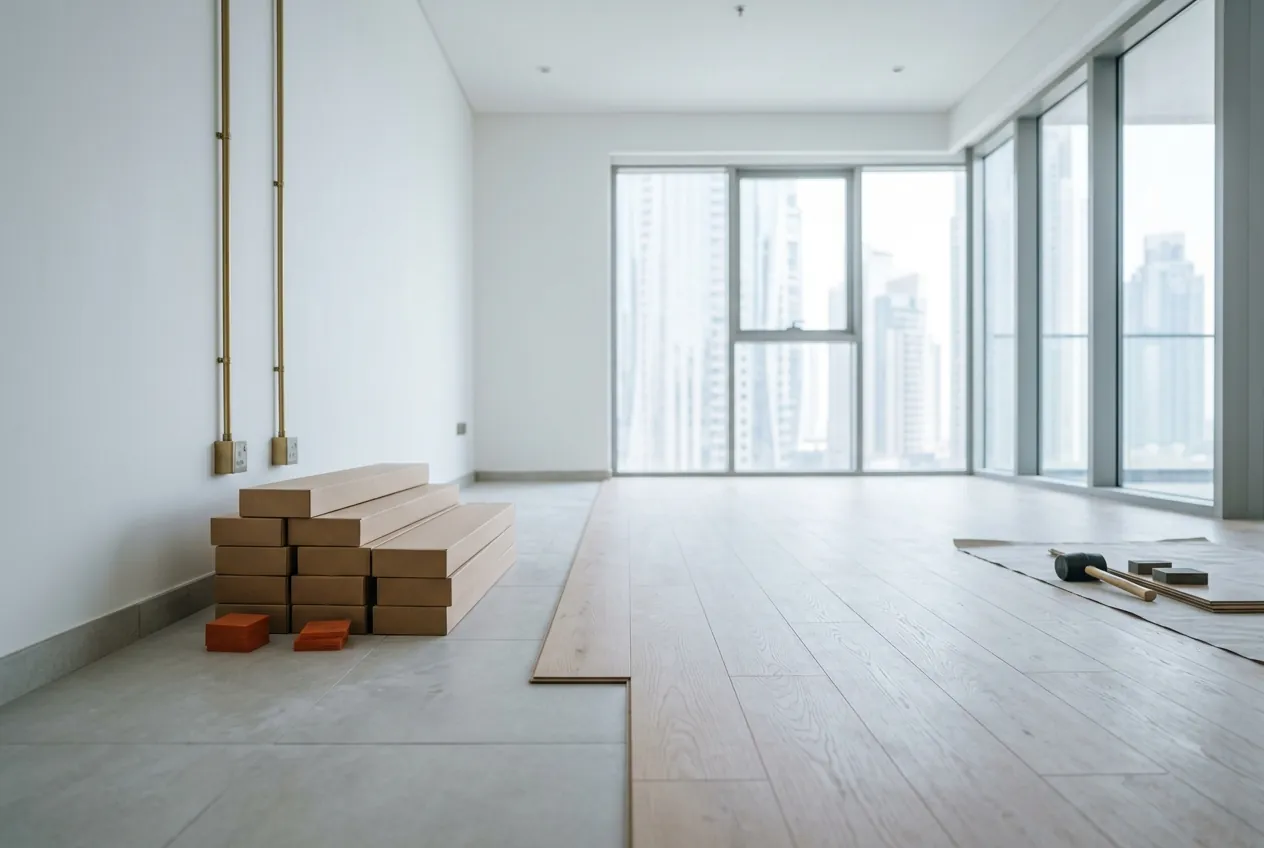
The rulebooks give no reason, but they agree on the method. Emaar lists the removal of existing tiles among the works not permitted in apartments and allows new tiles over the existing ones. Nshama's apartments manual for Town Square says it is not permitted to remove or replace the floor tiles, while new tiles may go on top of the existing ones, except on balconies.
Town Square also prices the overlay by material. Tiles glued on top of existing ones are a minor alteration, AED 1,000 with a 2 working day review. SPC tiles laid on top of existing ones fall in the home improvement tier at AED 160. Replacing floor tiles in wet areas, dry areas and balconies is a major alteration, and Town Square allows it in townhouses only.
An overlay raises the floor, so check the door clearances and the threshold to the balcony before choosing a thickness. That is a measurement, not a rule, and the contractor should take it before quoting.
Which floors need a permit?
From Dubai Municipality, none of the ordinary ones. Resolution 109 of 2022 lists replacing floors among basic maintenance works, which need no permit and no completion certificate, on condition that a contractor pre-qualified by the Municipality does the work. The Dubai Development Authority's Circular 318 exempts flooring replacement that does not affect the structure from its fit-out permit; the job runs on the landlord's or facilities manager's NOC or permit to work. On Trakhees land, where Palm Jumeirah sits, any modification or fit-out in a completed building needs a Modification Permit, so ask the contractor in writing which side of that line a new floor falls.
The building's approval is the one that matters. In Dubai Holding communities any alteration beyond maintenance needs an application on the community app, while its FAQ exempts like-for-like replacement, so a floor in a new material is an application and a repair is not. In Tilal Al Ghaf the community rules require written consent to alter or replace floor coverings of any kind.
Balconies, wet areas and SPC overlays
Three zones behave differently. Balconies are the most restricted: Town Square excludes them from tiles over tiles, and Dubai Holding requires prior written approval for balcony enclosures and any change to the external façade. Wet areas are held back in Town Square, which keeps wet-area tile replacement for townhouses; in any bathroom the new floor sits over the existing waterproofing, so ask the contractor how the overlay keeps it intact. SPC laid over the existing tiles is the cheapest overlay to approve in Town Square's tiers, and a full bathroom floor belongs with a bathroom renovation.
When can the floor be cut and laid?
Tile cutting and grinding are noisy work, so they run inside the building's windows: 9 AM to 1 PM and 3 PM to 5 PM in Emaar towers and under Dubai Holding's rulebook, 9 AM to 5 PM on business days in Town Square. Laying, grouting and fitting skirting can use the quieter part of the day. The hours by rulebook page has each clause with its date. Tile boxes cannot wait in the corridor either: Dubai Holding fines AED 150 for materials left in common areas without approval.
What a flooring quote should list
- The method: an overlay on the existing tiles, or removal where the building allows it, with the rule quoted.
- The area in square metres, room by room, and the material by brand and range.
- Levelling, adhesive and any underlay, and how door clearances are handled.
- Protection of the lift and corridor, and removal of offcuts and packaging.
- The building's approval: NOC, tier fee or written consent, and who applies.
None of the companies on our price guide publishes a per-square-metre flooring band for Dubai apartments. The nearest published figure is ASM Interiors' basic tier: painting, flooring and minor fixes in a one or two-bedroom unit for AED 15,000 to 40,000. The apartment prices page sets it beside the other bands, and a whole-unit job goes through our quote service.
Questions
Flooring questions
- Can I replace old tiles with wooden flooring?
- In Emaar and Town Square apartments, not by removing the tiles: any new floor, wood or otherwise, goes over them. Town Square's tiers put SPC tiles on top of existing ones at AED 160 as a home improvement. Elsewhere the building's rules decide, and Dubai Municipality needs no permit either way if a pre-qualified contractor lays it.
- Do I need the landlord's permission to change the flooring?
- Yes, in writing. In Tilal Al Ghaf even the owner needs written consent to change floor coverings. Agree in the same letter whether the new floor stays when the lease ends, and photograph the old floor first.
- Can I change the flooring on my balcony?
- Not by overlay in Town Square, where tiles over tiles are excluded on balconies and replacement is not permitted in apartments. In other buildings, ask the manager in writing before choosing a material.
- How much does it cost to change the flooring in a Dubai apartment?
- None of the companies on our price guide publishes a per-square-metre flooring band for Dubai apartments. The one published apartment band that names flooring is ASM Interiors' basic tier, AED 15,000 to 40,000 for painting, flooring and minor fixes in a one or two-bedroom unit, which prices more than the floor. Ask for the area, the material and the levelling as separate lines.
- Is a floor change noisy work?
- The cutting and grinding are. Emaar's apartment rules confine power tools to 9 AM to 1 PM and 3 PM to 5 PM, and Dubai Holding's rulebook uses the same windows, so a flooring programme is planned around six noisy hours a day.
Who you are dealing with
- OperatorWebsiteOS LLC
- Licence2646567.01
- Cost to homeownerNone
- Figures datedSeptember 2026
Tell us about the floors
Tower, community, the rooms and the floor you want. We come back with what your building allows and contractors who price the area, the material and the levelling separately.