
District cooling
Do you need a chiller NOC to renovate an apartment?
Rarely as a document of your own. Empower issues its NOCs to buildings, not units. What reaches a renovation is the rule that only Empower touches the chilled-water connection, and the building's own limits on moving AC equipment.
District cooling
Chiller NOC for an apartment renovation: who issues one?
A chiller NOC for an apartment renovation sounds like a single form. It is not. In a Dubai tower on district cooling, chilled water reaches the building from a provider such as Empower through an energy transfer station, and the provider's NOCs deal with that plant, filed by the building's own consultant and contractor. An owner renovating one unit meets the provider through a single rule, and meets the building through several.
Do you need a chiller NOC for an apartment renovation?
Usually not as a separate document. Empower's published NOC regime is building-level: its design, construction and chilled-water connection NOCs are filed by the building's main consultant and main contractor. What binds a renovation is Empower's Standard Conditions of Service, which reserve any work on the building's connection, valves included, to Empower's authorised representatives. The building's rules then decide what the unit's AC may change: Emaar does not permit relocating or covering MEP systems in apartments, and Dubai Holding needs prior written approval for external AC units.
What does Empower control inside a building?
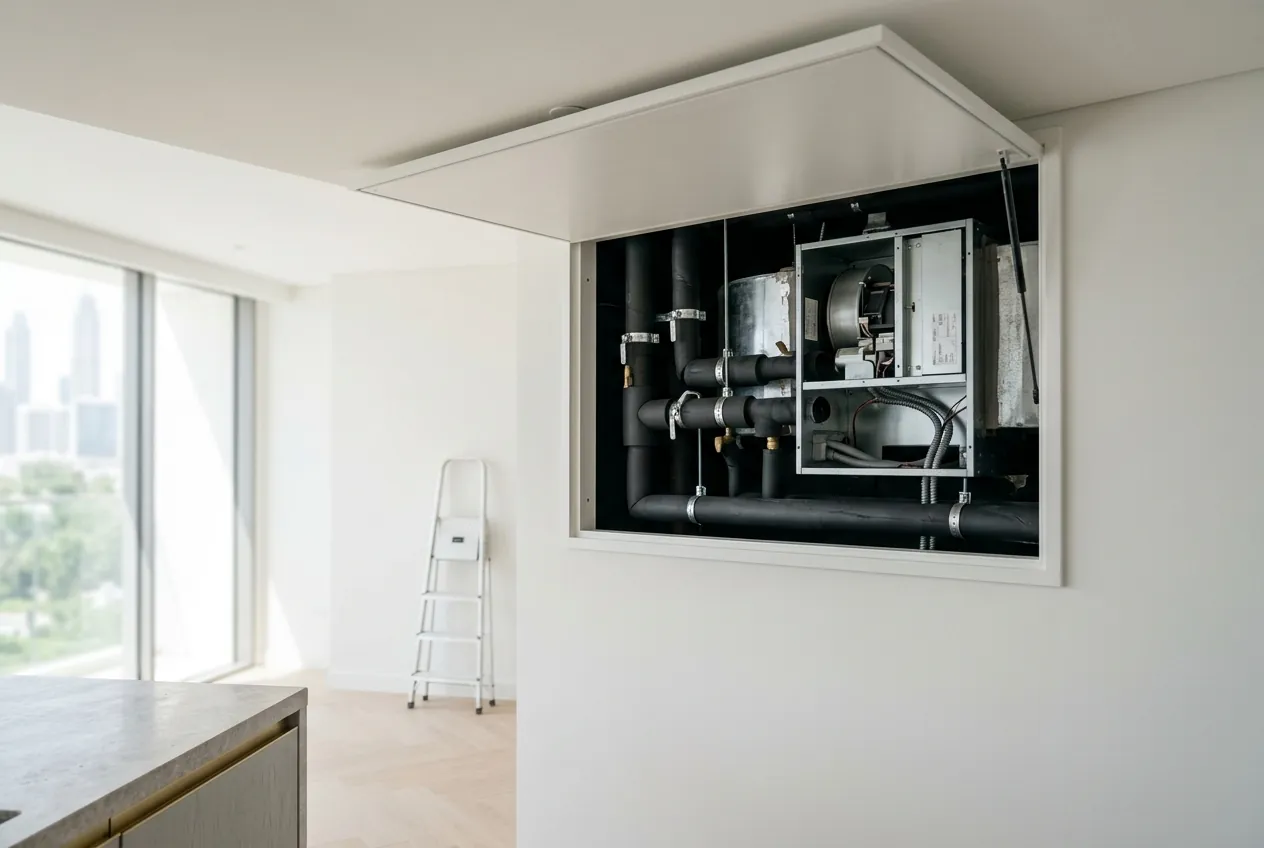
The connection, and the room it lives in. Empower's Standard Conditions of Service, effective from April 2009 in revision 02-04, say that outside an emergency no one other than an authorised Empower representative may open or close a valve on the building's district cooling connection, or alter, tamper with or modify it or its equipment, and no one else may tap, revamp or connect to a chilled-water main. The building owner must provide a secure room used only for the energy transfer station, with access for Empower's staff at any time.
The same conditions give Empower a lever: if access is denied, by a locked door, an inaccessible meter or unsafe conditions, it may disconnect after seven days' notice and charge a reconnection fee. None of this stops a renovation. It means the contractor works on the unit's side of the building's system, and never on Empower's.
Which Empower NOCs exist, and who files them?
| NOC | Filed by | What it covers |
|---|---|---|
| Design NOC | The building's main consultant | The ETS room design; Empower designs the primary side itself |
| Construction NOC | The building's main contractor | Building the ETS room works |
| Chilled Water Connection NOC | The building's main contractor | Connecting the building, with a water analysis report no more than two weeks old |
| NOC for Using Own A/C System | Applicant not stated | Named among Empower's other NOC types |
Empower publishes no fee and no turnaround for any of them, and its NOC documents carry no date. What an apartment owner can take from the list is that none is written for a single unit. When a contractor says a renovation needs a chiller NOC, ask which one, who files it and against which Empower document. For in-unit work, the approval that exists in the published documents is the building's own.
Is your tower on district cooling?
Empower publishes a list of projects rather than a service area. The current list includes Business Bay, Discovery Gardens, Jumeirah Beach Residence, Jumeirah Lake Towers, Jumeirah Village South, Dubailand Residence Complex, the Palm Jumeirah trunk and crescent, Al Khail Gate, Meydan, Bluewaters, Dubai Healthcare City and DIFC, among others. If the unit has an Empower account, it is on the network. In a 2008 circular for TECOM Sites C and D, the DDA asked consultants to state each project's Empower NOC status.
In a district-cooled tower, air-conditioning maintenance inside the unit is still basic maintenance in Dubai Municipality's terms, with no permit when a pre-qualified contractor does it. What the contractor may not touch is the chilled-water side.
The building's AC rules decide the design
For a single unit, the building's rules are the ones that shape an AC change. Emaar lists the removal, relocation or coverage of MEP and fire-fighting systems among the works it does not permit in apartments, so moving an air-conditioning unit, rerouting a duct or boxing in a return inside a false ceiling is off the table there. Dubai Holding's 2026 rulebook puts external air-conditioning units behind its prior written approval. The DDA exempts false-ceiling replacement from its fit-out permit only if no fire alarm or firefighting device is relocated, added or blocked.
Some communities write maintenance into the ownership itself. Tilal Al Ghaf's community rules require owners to keep a quarterly air-conditioning service contract with the master developer or an approved supplier, so a renovation there should leave the AC equipment where the service contractor can reach it.
Power is the other half. If the renovation needs the electricity off at the unit's panel, DEWA's Temporary Power Disconnection is free and needs the account holder's request 5 working days ahead. A job that adds electrical load goes through DEWA's connection service, filed by an enrolled contractor or consultant.
Tabreed and Abu Dhabi towers
In Abu Dhabi the district-cooling approval sits inside the permit chain. DMT's building permit procedures list Tabreed's approval on drawings among the entity approvals a building permit may need, each with a 6 working day target. A maintenance permit, the route for cosmetic work, can be requested without registering a project and bypasses that chain, so a refresh that leaves the interior spaces and the structure alone does not go to Tabreed. A layout change is a building permit filed by a design consultant, who carries the entity approvals. The hub's Abu Dhabi permits guide sets out both routes.
What the AC lines in a quote should say
- Whether the tower is on district cooling, and where the chilled-water side begins.
- Exactly which AC items change inside the unit, with the building's rule for each.
- Any work that needs the building's or the provider's approval, and who applies.
- Whether power has to be isolated, and who books the disconnection with DEWA.
We put those lines into every brief before contractors price the work. For scale, the published whole-unit bands start at AED 15,000 for a basic one or two-bedroom refresh, and the bands by publisher page lists them all.
Questions
District cooling questions
- Can I replace the AC units in my apartment?
- In a tower on district cooling, the unit's air conditioning runs off the building's chilled-water system, so replacing equipment is a question for the building management, and nobody but Empower may touch the connection itself. Emaar does not permit relocating MEP systems in apartments, so like-for-like in the same position is the realistic scope there.
- Does Empower charge for an NOC?
- Empower publishes no NOC fee and no NOC turnaround in any of its NOC documents or anywhere on its site. Its tariff figures carry no date, so we do not quote them.
- Can I switch from district cooling to split units?
- Not on your own. Empower lists an NOC for Using Own A/C System among its other NOC types without publishing who files it or on what terms, and Dubai Holding needs prior written approval for any external AC unit. Treat it as a building decision, raised through the management, not a renovation line.
- Is AC maintenance a permit job in Dubai?
- Not from the Municipality: maintaining air conditioners is basic maintenance under Resolution 109 of 2022, with no permit or completion certificate if a pre-qualified contractor does it. The building's entry or work permit for the contractor still applies.
- What about Abu Dhabi towers on Tabreed?
- Cosmetic work on a maintenance permit stays outside the entity-approval chain in which Tabreed signs drawings. A building permit for a layout change enters it, and the design consultant who files the permit handles the approvals, which DMT targets at 6 working days each.
Who you are dealing with
- OperatorWebsiteOS LLC
- Licence2646567.01
- Cost to homeownerNone
- Figures datedSeptember 2026
Tell us about the tower
Tower, community, whether it is on district cooling, and what you want changed. We come back with contractors who keep to the building's AC rules.